7:00 AM to 10:00 PM, seven days
Indoor Air Quality in Spring, TX
Air filtration systems, air purifiers, UV air purifiers, humidifiers and duct sealing for a house that is cool enough but never feels clean. Same equipment your attic already carries the ductwork for.
Why the filter in the hallway grille isn't the whole system
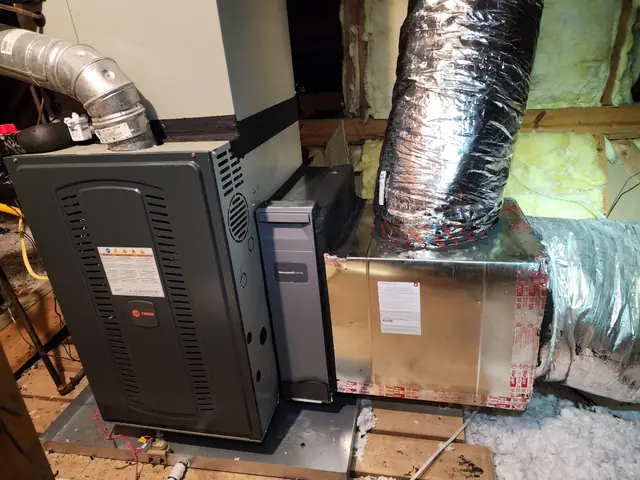
Most houses in Spring run a one inch throwaway filter tucked behind a return grille, and that filter is built to protect the blower motor, not to clean the air the family breathes. A media air cleaner cabinet, the kind mounted right at the air handler, holds a filter four to five inches deep instead of one, which means far more surface area for the same airflow and a MERV rating that can climb without choking the system down. That trade matters because a filter rated too high for a blower that was never sized for it just makes the fan work harder and pull air through gaps it shouldn't, rather than actually filtering more of what passes through the return. A UV air purifier mounted near the coil handles a different problem entirely, the biological growth that forms in the damp, dark environment inside the cabinet itself, and an air purifier working the return air stream is filtering particles a media cabinet's mesh is too coarse to catch. None of it does much good if the ductwork is leaking. A leaky return seam in the attic will pull hot, dusty attic air straight into the supply side before it ever reaches a filter, which is exactly why duct sealing sits on the same page as filtration rather than off on its own.
What a humidity problem actually looks like
A Gulf Coast house can sit at 74 degrees on the thermostat and still feel wrong, sticky in the bedrooms, condensation on a cold glass left on the counter, that faint mustiness that never seems to go away no matter how often the floors get mopped. That is a humidity problem, not a temperature problem, and a thermostat has no way to fix it because it only reads one number. A whole-home humidifier, sized to the square footage rather than to one room, and duct sealing that stops conditioned air from bleeding into the attic before it ever reaches a vent, are the two things that actually move the number that matters. KAC Express walks the attic, checks the return path, and tells you honestly whether the fix is a filter upgrade, a UV purifier, a humidifier, sealed ductwork, or some combination of the four, quoted flat rate before anything is installed.
KAC Express, licensed in Texas as TACLB33125E. Call (832) 326-5687.
What a MERV rating trades away, and what duct sealing gives back
A higher MERV number means a denser filter media, which catches finer particles but also resists airflow more, and a blower that was designed around a thin, cheap filter can struggle to pull air through a dense one without the static pressure climbing higher than the system was built to handle. That is the actual engineering trade behind "get the highest MERV you can" advice, and it is why the right answer depends on the equipment already installed rather than a number picked off a shelf at a hardware store. Duct sealing solves a separate but related problem: return ducts running through a hot attic develop gaps at the seams over years of expansion and contraction, and every one of those gaps is a straw pulling superheated, dusty attic air straight into the return stream before it ever reaches whatever filter is installed downstream of it. Sealing those seams with mastic, not just tape, keeps the filtration doing the job it was bought to do instead of fighting air it should never have seen in the first place.
Chasing an energy bill instead of an air quality problem? See energy savings and zoning, or check air conditioning repair if the cooling itself needs attention too. Full list on services, or go straight to contact to get a technician out.