What Actually Happens When an Attic Air Handler Leaks
The one part of an attic cooling system that decides whether a clogged drain line becomes a service call or a ceiling repair.
August 25, 2026 · 4 min read
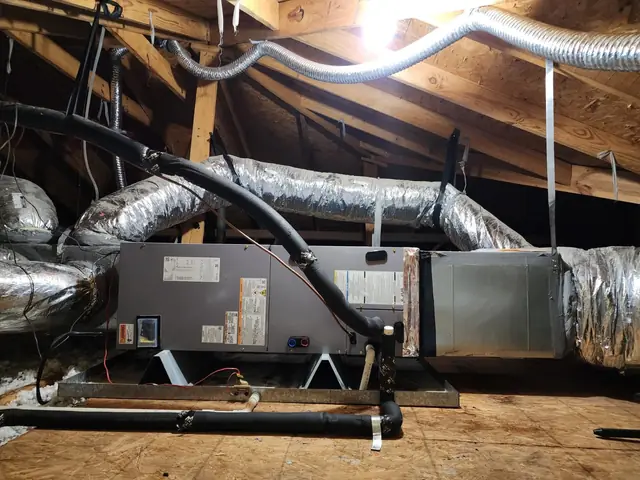
If your home was built anywhere around Spring, there's a good chance the guts of your cooling system live in the attic, not a closet. That's normal for this part of Texas. It also means the one part of the system most likely to cause real damage sits directly above your ceiling.
How the drain system is supposed to work
An air handler pulls warm, humid air across a cold coil. Moisture condenses on that coil the same way it beads on a cold glass, and all of that water has to go somewhere. It drips into a shallow pan under the coil, then runs out through a drain line, usually to the outside of the house or into a household drain. On most systems there's a second, backup drain line too, in case the first one clogs.
The part that actually saves your ceiling
Drain lines clog. Algae builds up inside the pipe over years of standing water, dust settles, and eventually the line backs up. When that happens, the water has nowhere to go except up and over the sides of the pan. A float switch sits in the pan for exactly this reason. It's a small mechanical switch that rides on the water level, and when the level rises past where it should, the switch cuts power to the system before the pan overflows. No float switch, or a broken one, and the first sign of trouble is a wet or stained ceiling.
We see this a lot, and it's an easy thing to miss
One of the more common findings during a routine check isn't a failing compressor or a bad capacitor, it's a missing or disconnected float switch. A homeowner will call about something else entirely, a noise, a weak vent, a system that feels like it's not keeping up, and during the inspection the tech finds the drain pan has no working safety switch at all. It's a quick, inexpensive fix, and it's the kind of thing that only gets caught because someone actually opened the panel and looked, rather than just checking the thermostat and moving on.
What you can check yourself, and what you shouldn't
You can look at the attic access, if you have one, for a water stain on the decking near the unit or on the ceiling drywall below it. A musty smell in a hallway closet under an attic run is also worth paying attention to. What you shouldn't do is go poking at the drain line or the electrical connections yourself. It's a live 240 volt circuit sitting a few feet from standing water, and the fix itself, clearing a line or replacing a switch, takes a technician a few minutes once they're up there.
Why this matters more in a Texas summer
Between the humidity coming off the Gulf and a cooling system that's running most hours of the day for months at a time, an attic unit here processes a lot more condensate than the same system would somewhere drier. A system in a milder climate might only run a handful of hours a day even at peak season. Around Spring, a system can run nearly continuously from May through September, which means the coil is pulling moisture out of the air almost around the clock. That's more water moving through the drain line, more opportunity for it to clog, and more reason to have someone check it before it becomes a ceiling repair instead of a service call.
Older homes carry an extra wrinkle here too. A drain line that was routed and sloped correctly when a house was built decades ago can settle over time as the structure shifts, leaving a low spot where water pools instead of draining freely. That pooled section collects sediment faster than the rest of the line, which shortens the time between clogs. It's not something you'd notice without getting up there and running water through the line to watch how it behaves.
What to do about it
If it's been a while since anyone looked at the drain pan and float switch on your system, or you've never had it checked at all, it's worth putting on the list before the next long stretch of hot weather. KAC Express has been doing this kind of work around Spring and the north Houston area since 2012, and a straightforward check like this is exactly the sort of thing that gets caught during a normal maintenance visit rather than after the damage is already done. They're licensed in Texas under TACLB33125E, quote flat-rate pricing before any work starts, and answer calls seven days a week from 7 in the morning until 10 at night. If something in your attic system doesn't feel right, the number is (832) 326-5687, any evening included.
KAC Express, (832) 326-5687
Call (832) 326-5687More articles
Why Texas AC Systems Fail in August, and What That Week Actually Looks Like
A look at why so many Spring-area systems finally give out in the same two weeks every summer, and what usually gives out first.
Repair or Replace: Thinking Through an Aging R-22 System Without Getting Sold
A straightforward way to think through an aging R-22 system before you commit to another repair or a full replacement.