Getting Real Airflow Out of a Two-Storey Spring Home
Why the upstairs of a two-storey Spring home never quite matches the downstairs, and what actually fixes it beyond turning the thermostat down.
August 25, 2026 · 3 min read
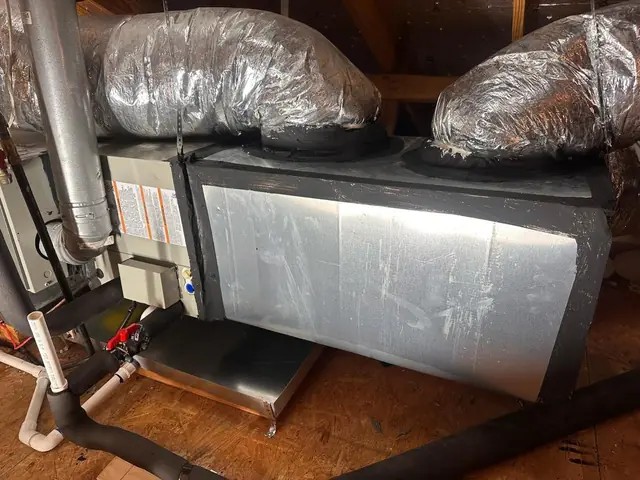
If the upstairs of your house runs warmer than downstairs no matter where you set the thermostat, you're not imagining it and you're not alone. It's one of the most common comfort complaints in two-storey homes across Spring, The Woodlands, and Klein, and it's usually not the equipment's fault. It's how the air is being distributed once it leaves the unit.
Why heat naturally collects upstairs
Warm air rises, so in a two-storey house the upper level absorbs heat from the roof all day and holds onto it, while cool air from a single system sinks and pools downstairs before it fully reaches the second floor. A single thermostat, usually mounted downstairs, reads the cooler air near it and tells the system to stop running well before the upstairs bedrooms have actually caught up. That's a structural mismatch between how the house behaves and how a one-zone system is controlled, not a sign the unit is undersized or broken.
What zoning actually does about it
A zone control system splits the ductwork into separate areas, each with its own thermostat and motorized dampers that open and close to send more or less air where it's actually needed. Instead of one signal deciding for the whole house, the upstairs zone can keep calling for cooling after the downstairs zone has already been satisfied. It's the most direct fix for a house where one level consistently runs warmer than the other, because it addresses the actual cause rather than just running the whole system longer and hoping the upstairs eventually catches up.
Duct sealing matters just as much as zoning
Even a well-zoned system loses ground if the ducts themselves are leaking air into the attic before it ever reaches a vent. Flex duct connections, especially at the plenum and at each takeoff, are sealed with mastic, a paste that hardens over the seam, rather than the fabric tape that tends to dry out and peel away within a few years in attic heat. A duct system with several leaking joints can be pushing a meaningful share of your conditioned air into the attic instead of the room it was meant for, which shows up as weak airflow at the vent and a system that runs longer than it should to hit the same temperature.
Filters affect airflow more than people expect
A higher MERV rating means a filter catches finer particles, but it also restricts airflow more, and a filter that's too restrictive for a given system can choke it down even when everything else is working correctly. The right filter is the one that matches what the system was actually designed to pull air through, changed on a regular schedule, not necessarily the highest rating on the shelf. A clogged filter has the same practical effect as leaking ducts: less air reaching the rooms that need it, and a system working harder for a worse result.
Humidity is part of comfort too, not just temperature
In this part of Texas, a house can hit the thermostat's set temperature and still feel uncomfortable because the humidity in the air hasn't come down with it. A system that's properly sized and running long, steady cycles pulls more moisture out of the air than one that's short cycling on and off. That's another reason a house with airflow problems can feel muggy and uneven even when the number on the thermostat looks right.
Where to start if this sounds like your house
- Notice whether the imbalance is worse in one specific room, one whole floor, or the whole house evenly
- Check whether return air vents are blocked by furniture or closed doors, which restricts airflow at the source
- Have someone look at the actual duct runs and connections, not just the equipment, before assuming the unit itself needs replacing
KAC Express installs and services zone control systems and handles duct sealing for homes throughout Spring, Tomball, Kingwood, and the rest of the north Houston service area. If one part of your house has never been comfortable no matter what you do to the thermostat, it's worth a real look at the ductwork rather than just living with it. Call (832) 326-5687, seven days a week, 7am to 10pm.
KAC Express, (832) 326-5687
Call (832) 326-5687More articles
What Actually Happens When an Attic Air Handler Leaks
The one part of an attic cooling system that decides whether a clogged drain line becomes a service call or a ceiling repair.
Why Texas AC Systems Fail in August, and What That Week Actually Looks Like
A look at why so many Spring-area systems finally give out in the same two weeks every summer, and what usually gives out first.